Engineering · 2026.10.10 · 5 min
The Admin Side of a One-Person SaaS: Trade-offs in Permissions, Broadcasts, and Notification Channels
Once my lending platform had users and billing, I built an admin console and multi-channel notifications; this covers permissions, kill switches, broadcast transaction boundaries, Telegram binding, and recipient rules for targeted broadcasts.
Reading

Once the platform grew from a bot into a service with users, billing, announcements, and operational actions, I built the admin side in several phases around a single principle: every high-risk control has to be adjustable at runtime, have checkable permissions, and leave a record, instead of being scattered across environment variables. On the notification side, the principle is that each channel fails on its own, without dragging down the other channels or touching the main transaction flow. The most recent change lets a broadcast target specific users, and the hard part was the recipient rules. Targeted sends and segment sends follow different rules, and mixing them makes the count on screen impossible to explain.
Admin: dangerous switches must be checkable and leave a record
If admins can only query the DB directly or edit config files, there's no permission boundary and no audit context. So the admin console was split into phases that could ship independently. First came the shell, user lookup, auditing, and viewing the app as a given user. Then came role permissions, billing, broadcasts, maintenance windows, feature flags, and kill switches.
A few key decisions:
- Permissions are decided by four roles plus a capability matrix, not by whether the UI shows a particular button.
- A kill switch affects every user's fund operations, so toggling one requires a 2FA step-up.
- Maintenance windows go through one shared check, instead of each feature deciding for itself whether we're in maintenance.
- Broadcasts need durable scheduling and only dispatch after the transaction commits. That way mail never goes out before the transaction is committed, and a schedule never gets written to the DB without being sent.
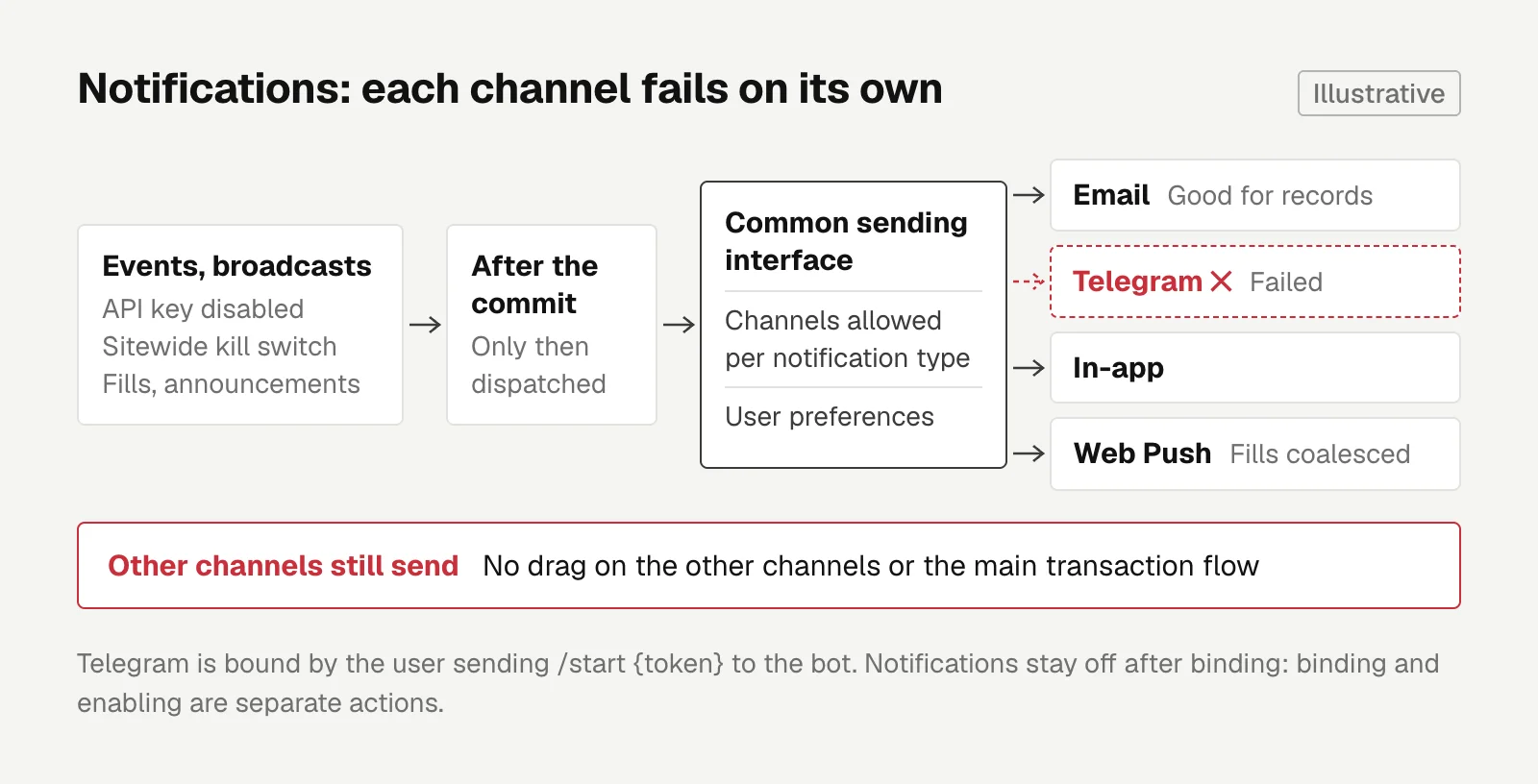
Notifications: each channel fails on its own
Email is good for keeping a record, but it's too slow for events like an API key being disabled or a sitewide kill switch. If every event sends its own notifications directly, channel failures and preference settings are hard to keep consistent. So I first pulled notifications into a common sending interface, with Email and Telegram as two parallel channels that can fail independently.
Telegram is bound by the user sending /start {token} to the bot themselves. After binding, notifications are off by default. Binding and turning notifications on are two separate actions, because I don't want getting a chat id to count as implicit consent. Clicking a link alone won't start messages.
Later I added a per-user notification history, event categories, preference settings, and an in-app notifications page, and only after that, browser Web Push as the fourth channel. Web Push can reach users who don't have the page open, so which channels each notification type may use and how users set their preferences both need to be controllable. Fill events also got a coalescing window so high-frequency events don't turn into a flood of push notifications. These phases were merged one after another, because the top nav, API client, i18n, and styles are shared files, and changing them in parallel would just mean constant conflicts.
Targeted broadcasts and "Lending paused"
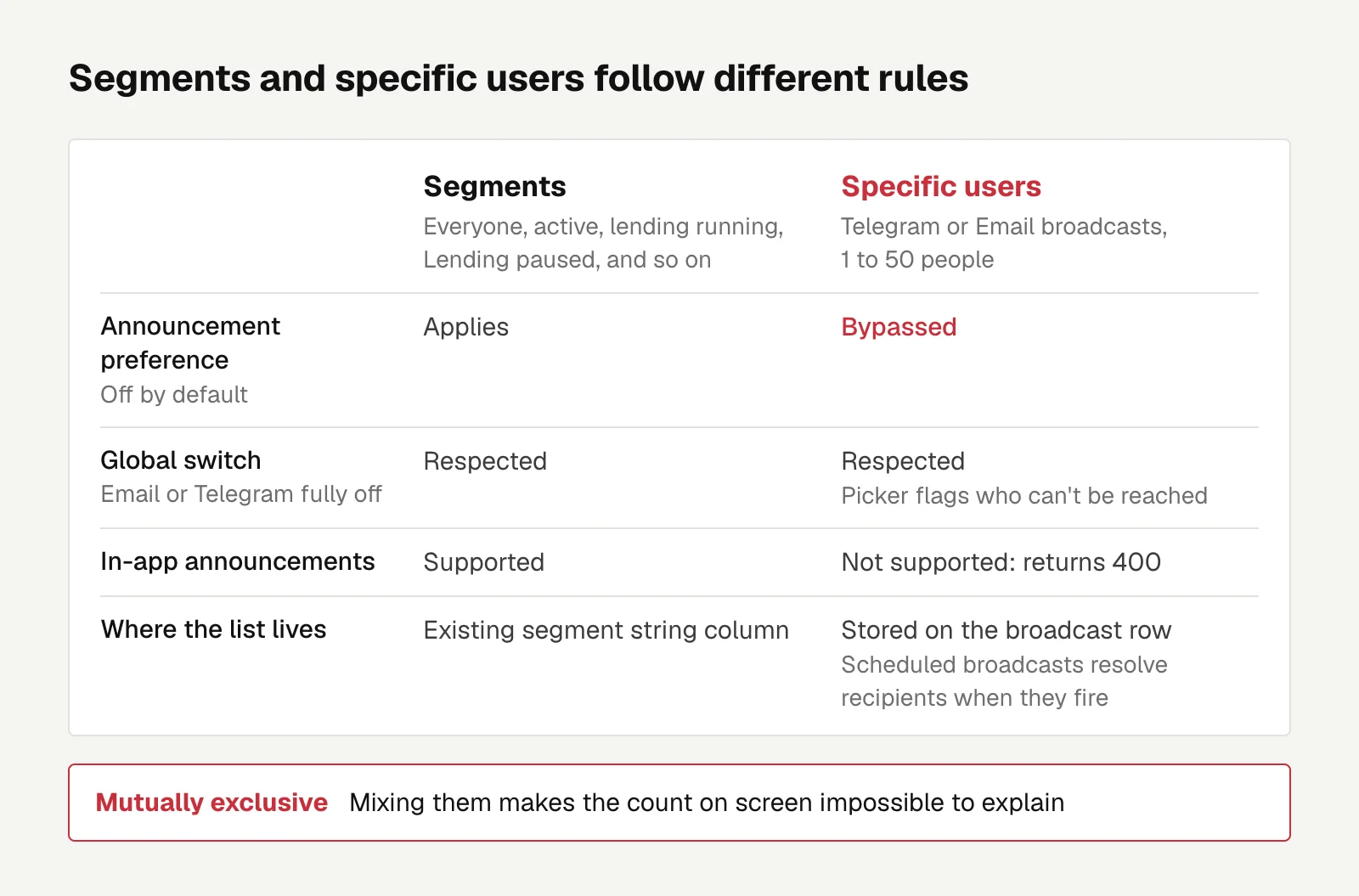
Originally a broadcast could only target segments (everyone, active, lending running, and so on), with no way to send to just one or two people. Telegram and Email also had an extra announcement notification preference that's off by default, so under the segment rules almost nobody could be reached.
I added "Specific users": in a Telegram or Email broadcast, you search by email or name and pick 1 to 50 people. Here are the rules I settled on:
- Targeted users bypass the announcement preference but respect the global switch. Targeting is an operator contacting particular people, not a mass announcement. But if a user has turned off Email or Telegram notifications entirely, they still don't get it, and the picker marks who can't be reached.
- Specific users is mutually exclusive with the other segments. Segments go through the announcement preference and targeted sends don't, so mixing the two makes the count on screen impossible to explain.
- In-app announcements don't support targeting. In the data model, an in-app announcement is a single sitewide row that can only be filtered by segment at read time, so the backend just returns 400.
- The list is stored on the broadcast row. A scheduled broadcast resolves its recipients only when it fires, so the list has to travel with the broadcast. I also considered encoding user ids into the existing string column that holds the segment, but that column is only 200 characters, and the history page would need its own parsing.
I also added a "Lending paused" audience: people with an enabled API key who have either turned off lending themselves or been suspended for billing reasons. It uses the same check as the "Paused" bot status on the admin users page, so the counts on both pages match. Pauses caused by the sitewide kill switch aren't included.
What I learned
- Permission checks belong in backend capabilities. Which buttons the UI shows is just presentation.
- If asynchronous dispatch needs to read data written in the same transaction, it has to trigger only after the commit.
- Having a user's contact channel doesn't mean they agreed to receive notifications. Keep binding and enabling separate.
- Don't mix audiences with different recipient rules in the same send, or the count turns into a number nobody can explain.

Tools
A Monthly Bitfinex Lending Rate Report: Public Data for the Numbers, a Scheduled PR for Review
The rate report is calculated only from Bitfinex's public candles, so anyone can reproduce it. A Claude Code cloud routine opens a PR every month, but nothing merges until a person reviews it.
Letters
Loading comments…