Investing · 2026.10.10 · 6 min
Does Lending Longer Pay More? Backtesting 30-Day and 120-Day Lending on Bitfinex
Long-tenor funding quotes far higher rates, but most loans repay within an hour; after fixing two inflating backtest bugs, here's the one lane that survived, how fragile it is, and the 120-day lock-up risk.
Reading

Long-tenor lending looks like it pays a lot more, but most 30-day loans are repaid within 40 minutes. The real extra earnings come from the few loans that borrowers keep for many days. After I fixed two errors that inflated the backtest, only one form was worth trying: when the 2-day quote is high enough but still below the current FRR (Bitfinex's Flash Return Rate), post the same price as a 30-day offer instead. It was positive in all three years and added a few dozen bp, but the gains were concentrated in about twenty events, so I wrote down the stop-loss line before starting the trial. I also added a lane that takes 120-day bids, off by default.
The previous post switched 2-day quoting to the batch top yardstick with a fixed 2-day tenor, because the batch auction structure lives mostly in 2-day: the vast majority of 2-day fills land in batches, under half of 7-day fills do, and only a little over a tenth of 30-day fills. The old strategy would switch to 7 or 30 days when the 2-day quote was high enough, and batch_top dropped that. What I wanted to know: if I add a long-tenor lane on top of batch_top and give it part of the capital, does overall annualized return go up?
High nominal rates, but you can't capture much of them
Before writing any code, I wrote down the bar. Backtest three years (2023-10 to 2026-09), pair it against pure batch_top with the same seed, and only consider building it if it's still positive after stacking pessimistic assumptions: stricter fill rules, some offers never filling, and borrowers keeping the money for the full term whenever rates rise.
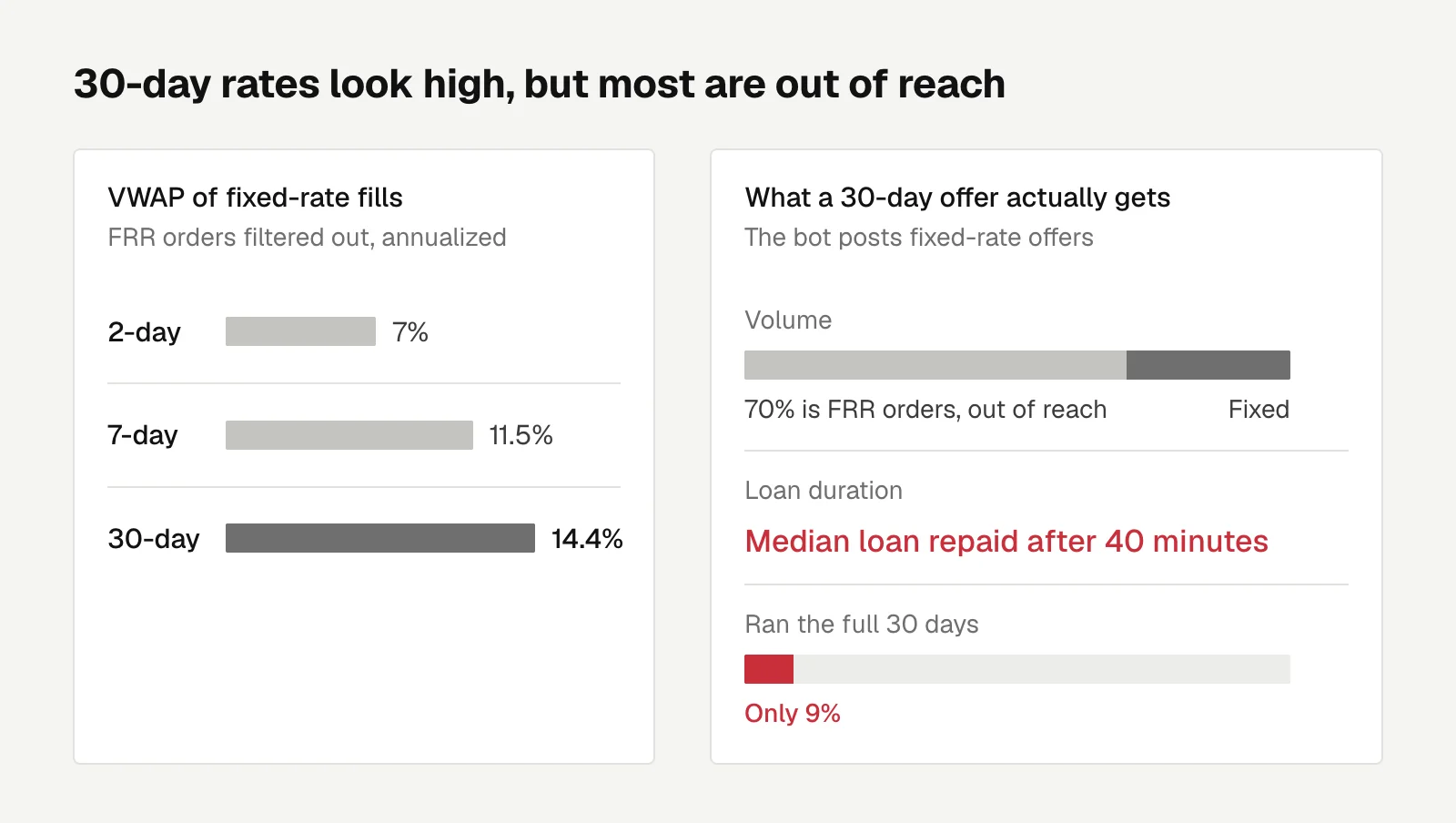
With FRR orders filtered out, the VWAP of fixed-rate fills was roughly 7% for 2-day, 11.5% for 7-day, and 14.4% for 30-day. On those numbers alone, long tenors look like free money. But 70% of 30-day volume is FRR orders, and my bot posts fixed-rate offers, so that part is out of reach.
Loan duration matters just as much. The fill model was calibrated on 30-day and 7-day offers the bot had posted itself, with recall above 90% for both, and durations were sampled from the bot's own credits of the same tenor. The median 30-day loan was repaid after 40 minutes, and only 9% ran the full term. I checked whether those full-term loans showed adverse selection. Market rates during their lifetime were all below the locked-in rate, which is good news for the lender.
Two places the backtest inflated returns
I had a subagent review this round twice.
The first review caught a bug. The backtest booked the entire interest at the moment of the fill, including days after the window ended, and that inflated the August 30-day lane by 4 to 5 times. The longer the tenor, the larger the share of interest that falls outside the window, and the easier it is to make this mistake.
The second was the devil's-advocate pass, and it caught two things. Loans at spike prices are repaid faster than average: high-rate 2-day fills were borrowed for only about a third as long as ordinary ones. And there was no calibration data for 30-day fills above FRR, so the model was guessing in that range.
After the fixes, the estimated gains were cut by 40 to 50%, and a new condition came with it: only repost as 30-day when the quote is below the current FRR.
Keep one form, write the stop-loss first
In the end I kept only "repost spikes as 30-day," using at most a portion of the capital. The 7-day version, a standing 30-day offer at a fixed price, and a version that quotes at market percentiles are all out.
After the fixes, 35 of 37 months were positive, and about 60% of the gain survived with every pessimistic assumption stacked. But the gain is fragile. It depends almost entirely on the few 30-day loans that were kept for many days, and that slice comes from about 20 independent events. With half as many events, the edge drops to about 40% of the original. With a quarter, it roughly breaks even.
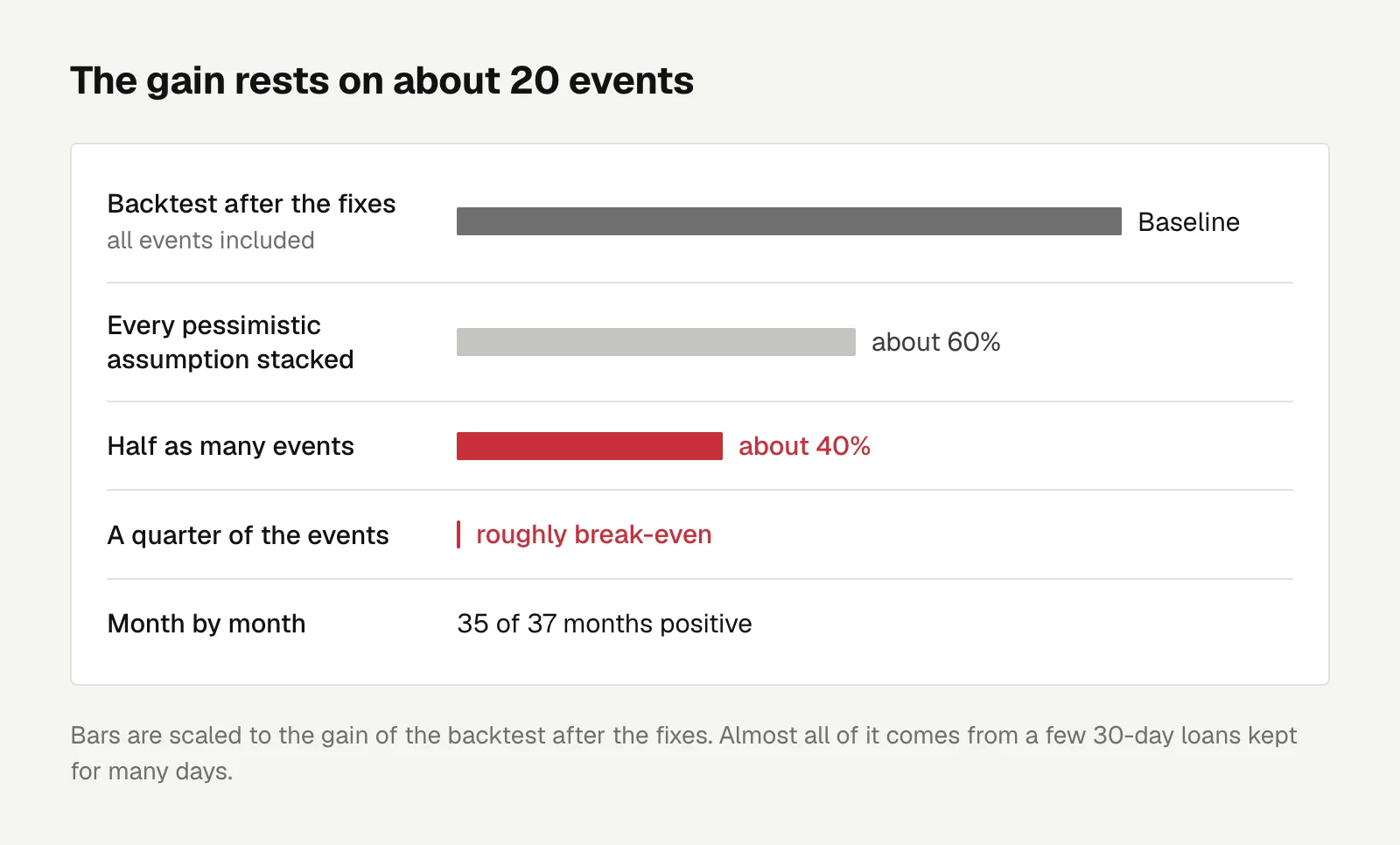
The backtest can't give more confidence than that. Only live testing can. So before the trial I defined the primary metric: for 30-day credits opened by the lane, weighted by amount, how long the portion beyond the first day lasts on average. Above a certain value, continue. Below a certain value, shut it off. The trial runs at least 3 months. The stop-loss line was written before launch, so later I just read off the table instead of talking myself into something on the spot.
120-day bid-take and lock-up risk
The research turned up one more observation. Starting in mid-August, the fUSD 120-day best bid sat around 10% annualized for a long time. With passive offers only, that capital would just keep rolling slowly through 2-day loans. So I added a bid-take lane that hits this bid directly as a taker, on three conditions: the bid is above a minimum annualized threshold, the config allows 120 days, and the capital already locked in 120-day loans is under its cap.
The lane's cap defaults to 0, which means it's off by default, and behavior is byte-identical to before the change. Once it's enabled, capital can be locked for weeks to months, so the cap is the only gate. I wanted to see the behavior before deciding how large to make it. After launch I set a modest cap.
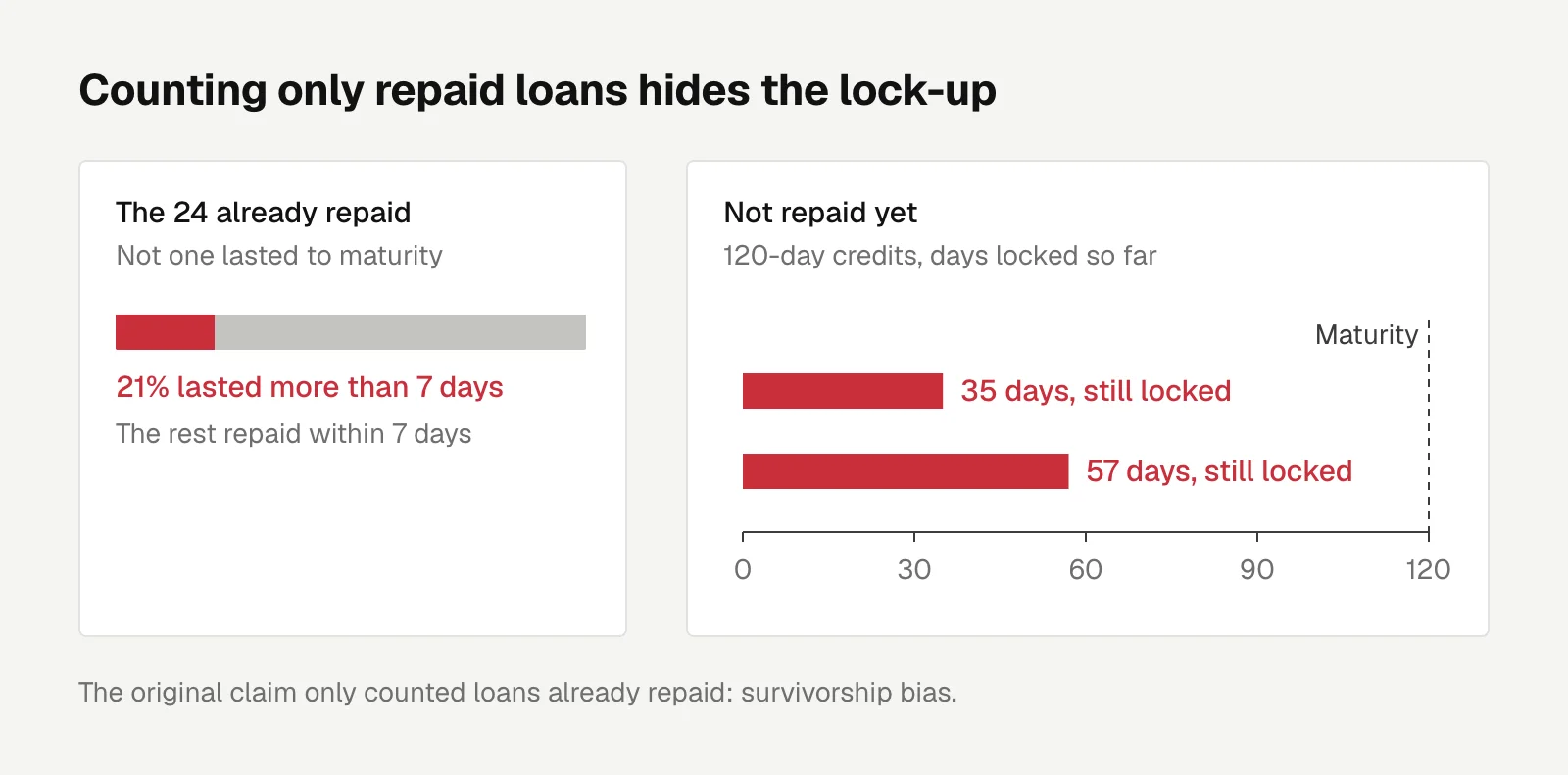
Early on, one claim was very reassuring: of the 24 120-day credits already repaid, not one had lasted to maturity. That's survivorship bias, because it only counted the ones already repaid. Recomputed properly, 21% of the repaid ones lasted more than 7 days, and two more had been locked for 35 and 57 days and still hadn't been repaid. The lock-up risk is real.
The 30-day and 120-day lanes have separate caps, and in the worst case they stack. Both caps can be adjusted instantly with SQL and the amounts are still small, so I haven't closed that gap yet. The bid-take fills later set off a chain of accounting problems, but that's a story for a separate post on reconciliation.
What I learned
- The value of long tenors isn't the rate premium itself. The real extra comes from a few loans kept for many days, and only live testing can confirm that slice.
- Backtest interest has to accrue period by period instead of being booked all at once at fill time. The longer the tenor, the more it inflates.
- Counting only finished samples will always be optimistic about lock-up risk. The unfinished ones are the risk.
- When gains are concentrated in a few events, write the stop-loss line before the trial.

Tools
Clickable Bands in the Terminal: Reworking leftovers and What It Still Can't See
After shipping my Claude Code mods, I made the bands clickable within limits like uncolorable Buttons and hover misclicks, taught leftovers absolute paths and variable substitution, and listed what command matching still misses.
Letters
Loading comments…